Hengjiang Intelligent Technology Co., Ltd. is a professional manufacturer and supplier of baking robot systems and food-grade industrial automation equipment. Our product portfolio covers standalone Delta and SCARA robots, flexible robotic workstations, and full-line sorting and packaging systems — all engineered for high-speed, high-precision, hygienic operation in modern bakery and frozen food production environments. Whether you are looking for a single-unit robot to automate one process node or a complete turnkey line for donut, pizza, or egg tart production, Hengjiang provides scalable, modular solutions that reduce labor costs, eliminate human error, and raise throughput to meet the demands of smart factory standards.
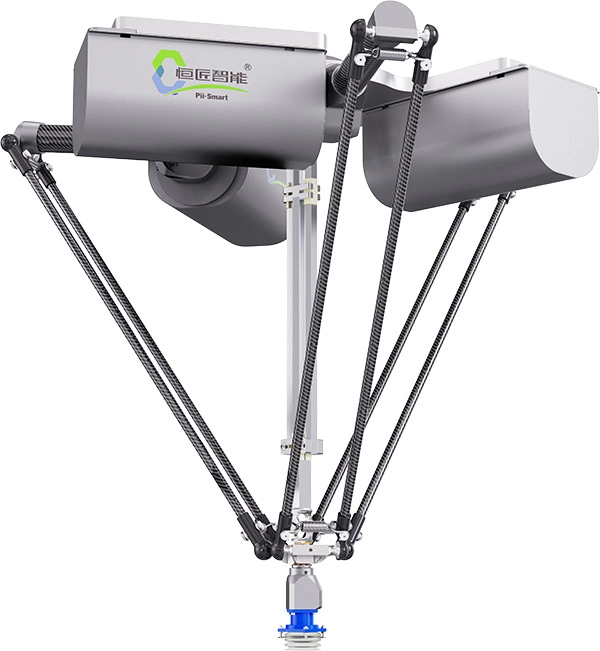
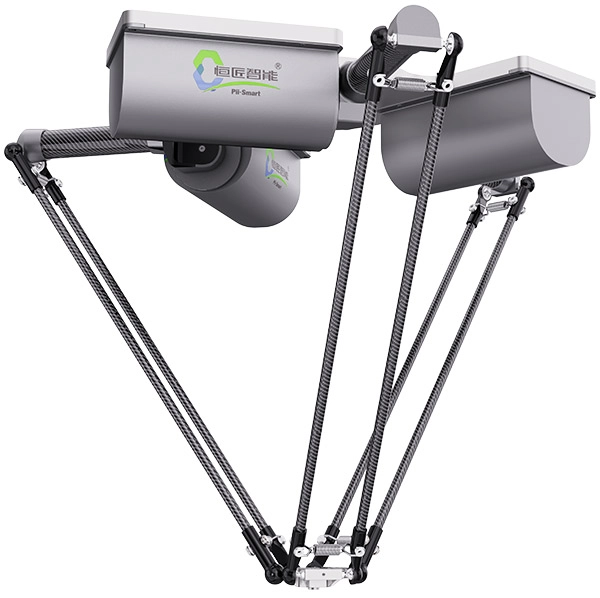
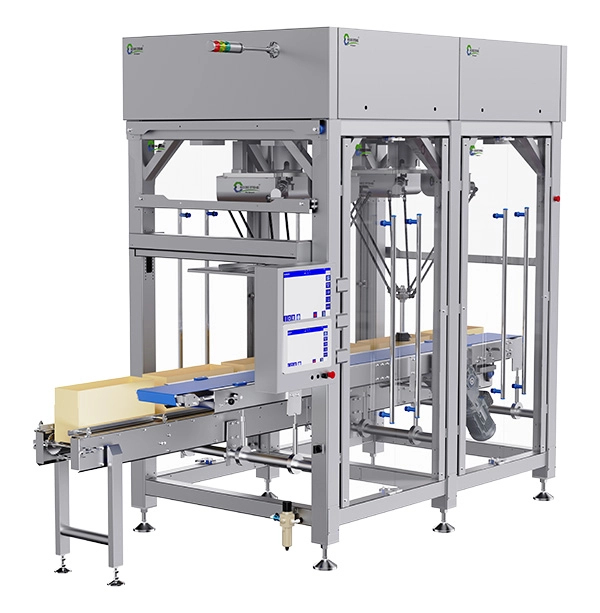
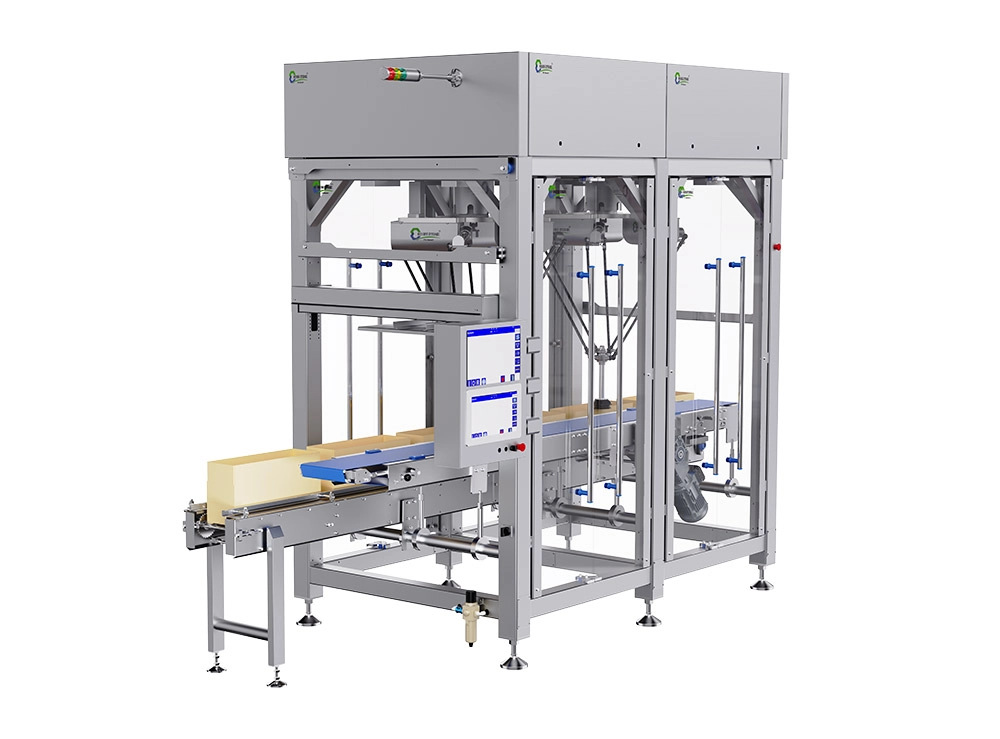
As experienced delta robot manufacturers, Hengjiang designs and produces its HJ-D11003-1 series parallel manipulators from the ground up, covering mechanical structure, motion control firmware, and end-effector tooling. A delta robot operates on a parallel kinematic architecture: three independently driven arms are connected to a fixed upper frame, and all joint actuators remain on the stationary base rather than moving with the arm assembly. This keeps the moving mass extremely low, which is the core reason delta robots can achieve cycle rates and accelerations that serial-arm robots cannot match.
Technical architecture of the HJ-D11003-1 series: The three upper arms are driven by servo motors mounted concentrically on the base plate. Carbon-fiber or aluminum lower links transmit motion to the central moving platform through ball-and-socket joints, eliminating backlash. The standard non-rotating-axis variant handles pure XYZ pick-and-place, while the rotating-axis variant adds a fourth axis (R axis) at the end effector, enabling orientation correction during picking — critical when products arrive at random angles on the infeed conveyor. Payload capacity targets lightweight products (typically under 3 kg per unit), with working envelope diameters commonly in the 800–1,100 mm range and vertical stroke up to 300 mm.
Control and vision integration: Each robot is paired with a servo drive cabinet and a dedicated robot controller running Hengjiang's motion planning software. Machine vision is handled by an industrial camera mounted coaxially above the conveyor belt. The vision system streams product position and angle data to the controller in real time, which then calculates individual robot pick assignments within the multi-robot cluster. The communication protocol between the vision host and the robot controller uses standard industrial Ethernet (EtherCAT or Modbus TCP), allowing integration with third-party SCADA systems without additional middleware.
Hygienic design considerations: All surfaces exposed to the food zone use 304 or 316 stainless steel fasteners and food-safe polymer link housings. IP65-rated motor enclosures prevent ingress of steam and washdown water. Cable management routes wiring through sealed conduit channels, eliminating horizontal surfaces where debris could accumulate.
Applicable products: donuts, dumplings, steamed buns, croissants, egg tarts, chocolate pieces, and other formed or molded baked or frozen goods. The HJ-D11003-1 is available in both non-rotating and rotating-axis configurations; see each model detail page for exact kinematic parameters, reach envelopes, and payload ratings.
For companies evaluating delta robot manufacturers globally, Hengjiang offers factory acceptance testing (FAT), remote commissioning support, and OEM/ODM cooperation. Reference video demonstrations of delta robots in live donut and pizza sorting lines are available in the baking robot video library.
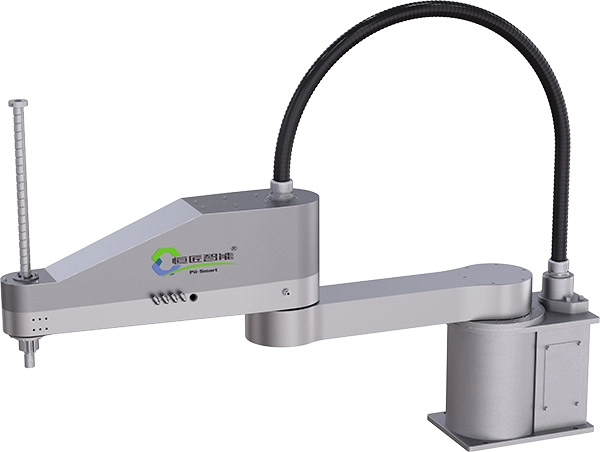
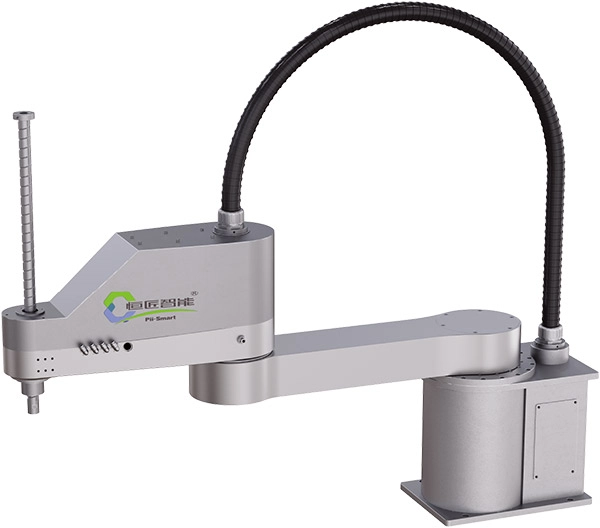
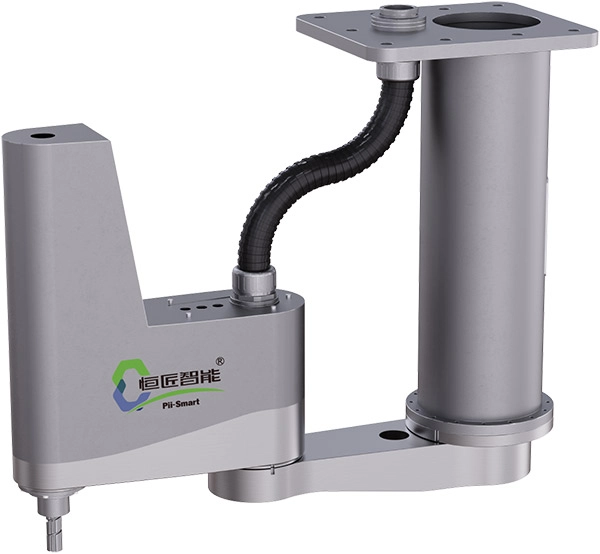
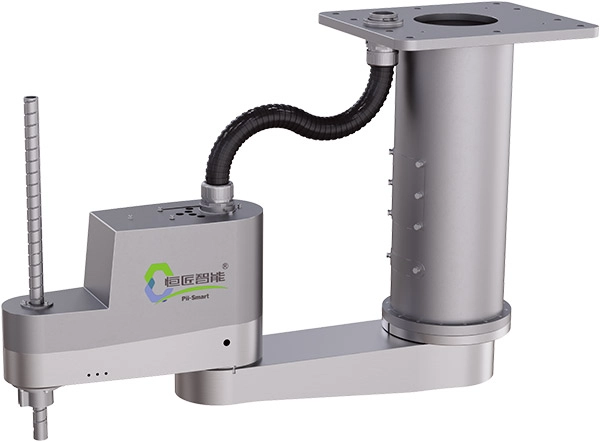
Understanding SCARA robot price factors is essential before committing to an automation project. Hengjiang's SCARA robots (Selective Compliance Assembly Robot Arm) are independently developed and manufactured, which means pricing reflects actual engineering value rather than distributor markups. The current lineup includes four models — HJ-SC1250-R, HJ-SC1050-R, HJ-SCD0625A, and HJ-SCD7840 — differentiated by arm reach (625 mm to 1,250 mm), payload (5 kg to 30 kg), and Z-axis stroke.
What determines SCARA robot price? Five primary factors govern the final cost of a food-grade SCARA system:
Arm reach and payload class: Longer reach and higher payload require heavier structural components and larger servo drives, directly increasing unit cost. The HJ-SC1250-R, for example, covers a 1,250 mm reach with 30 kg payload capacity, suitable for pallet-layer handling, while the HJ-SCD0625A targets precision sorting at a 625 mm reach with a lighter payload envelope and correspondingly lower price tier.
Axis count: Standard SCARA robots operate on four axes (J1 rotation, J2 rotation, Z linear, R wrist rotation). Some configurations add a fifth axis for complex orientation tasks. Additional axes increase servo count and controller complexity, affecting price.
Vision system inclusion: A standalone robot unit quoted without a vision system represents the base price. When bundled with Hengjiang's integrated machine vision module — high-resolution industrial camera, LED ring illumination, real-time image processing unit, and calibration software — the system price increases but delivers a turnkey solution ready for immediate deployment.
Mounting configuration: The HJ series supports ceiling-mounted (inverted) installation as standard, which optimizes floor space and improves accessibility for cleaning. Custom floor-stand frames or gantry mounts for special layouts carry additional engineering and fabrication costs.
Control system and software license: Hengjiang's integrated drive-control cabinet combines servo amplifiers, the robot motion controller, safety relays, and the HMI touchscreen in one enclosure. The self-developed software platform supports remote monitoring, over-the-air firmware updates, and recipe management for multi-product lines, all included in the standard package.
Key SCARA technical specifications: Repeat positioning accuracy is ±0.025 mm across all four axes, validated over a 100,000-cycle endurance test. Maximum end-effector linear speed reaches 2 m/s. The entire robot body weighs approximately 40 kg, simplifying overhead structural requirements. All joints are sealed to IP54 minimum, with IP65 available for washdown environments.
For detailed pricing of each model and configuration, contact Hengjiang's sales team through the online inquiry page.
The SCARA robot workstation from Hengjiang is a pre-engineered automation cell that integrates a food-grade SCARA robot, machine vision, infeed and outfeed conveyors, a stainless-steel frame, safety guarding, and a unified control cabinet into a single deployable unit. This workstation-level integration significantly reduces on-site engineering time compared to purchasing individual components and integrating them independently.
Core workstation architecture: The cell layout positions the SCARA robot centrally above the infeed conveyor. A vision station upstream of the robot's working envelope captures images of each incoming product. Processed coordinates are forwarded to the robot controller via EtherCAT within 20 ms latency, ensuring the robot receives accurate pick data before the product reaches the pick zone. Outfeed conveyors on one or both sides carry sorted products to downstream packaging or tray-loading stations.
The flagship application demonstrated at Hengjiang is the Frozen Egg Tart Shell Sorting and Stacking Workstation. In this configuration, freshly demolded frozen egg tart shells arrive on the infeed belt in random orientations. The vision system identifies each shell's center position and orientation angle. The SCARA robot picks each shell and places it into a designated stack position with ±0.02 mm repeatability, forming uniform stacks of a preset count that are then transferred to the packaging station. The cell achieves throughput rates that exceed what three to four manual operators can produce, with zero contamination from human contact.
Hygienic construction details: The workstation frame is fully welded 304 stainless steel with electro-polished surfaces. Conveyor belts use food-grade PU material. All pneumatic components for the end-effector gripper are mounted within the sealed robot arm housing, not exposed externally. The electrical cabinet is installed outside the food zone to prevent heat and electromagnetic interference from affecting product quality.
Scalability: A single SCARA workstation can be operated standalone or networked into a larger SCARA robot sorting packaging line that includes automatic tray loading, cartoning, and case packing. The modular communication architecture (OPC-UA compatible) allows the workstation to report production data — cycle count, reject rate, gripper force telemetry — to a central MES or ERP system.
This workstation is also the entry-level integration path for manufacturers who want to automate one process step before committing to a full-line solution. See the service and support section for installation, acceptance testing, and operator training details.
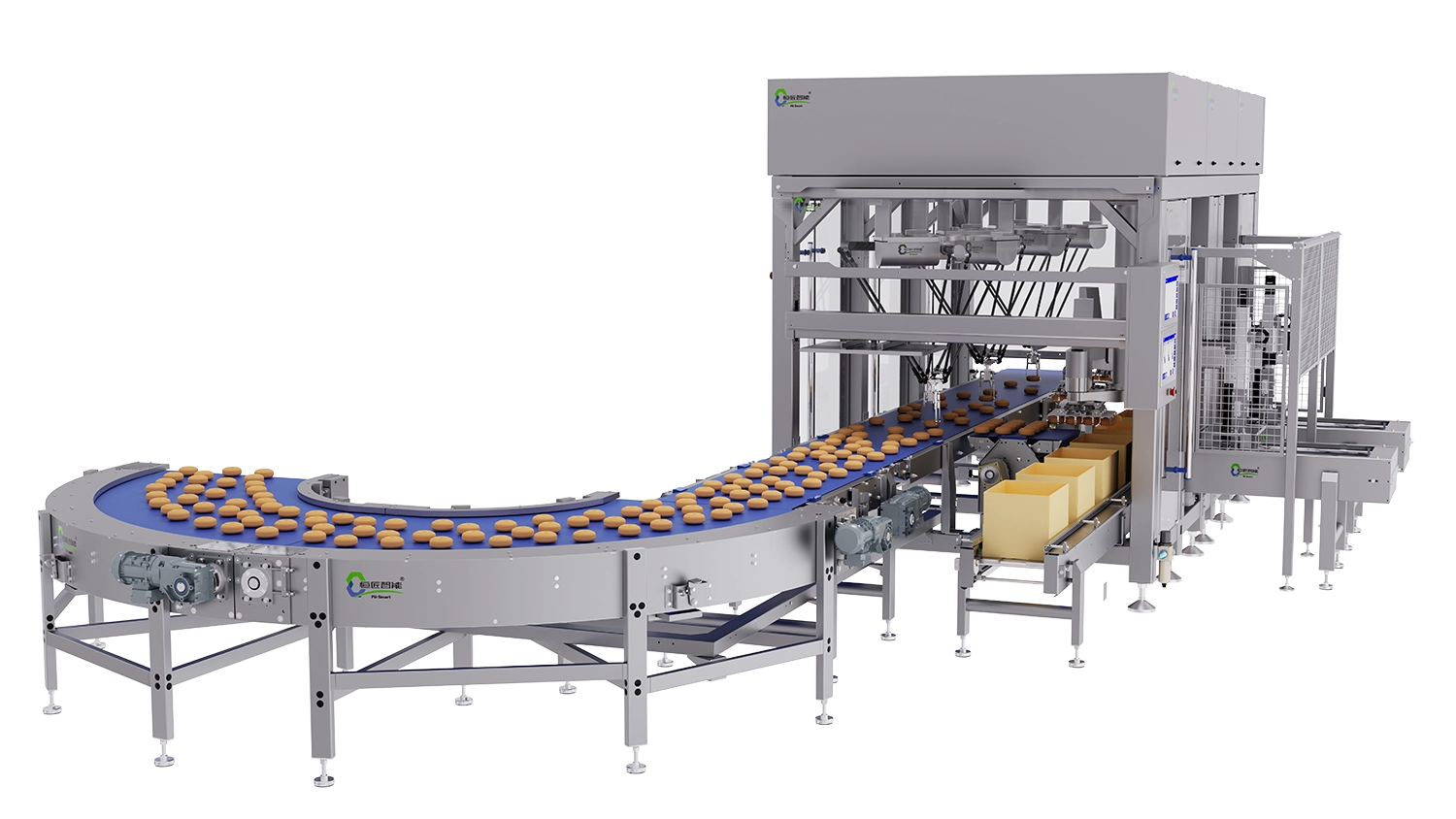
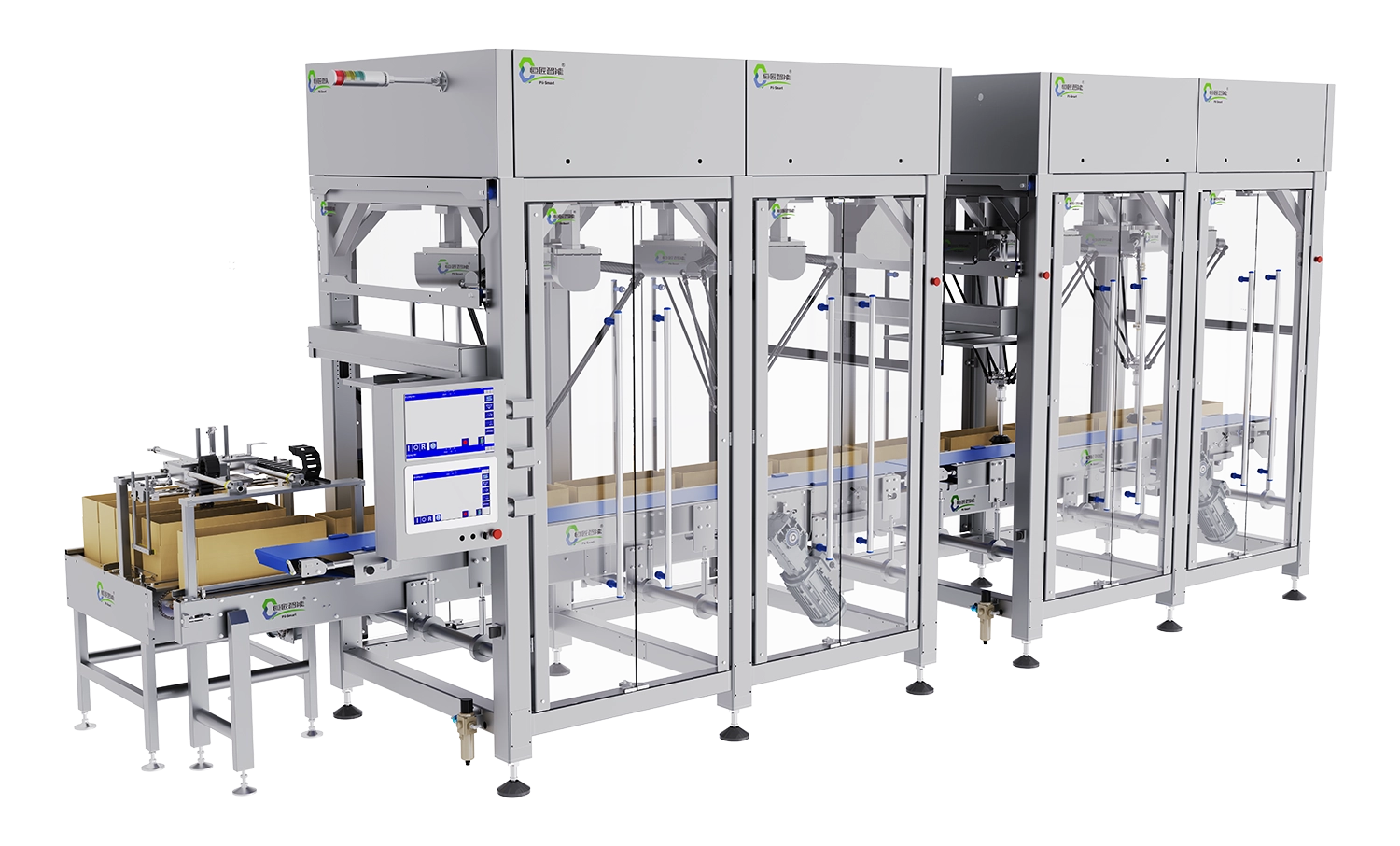
The delta robot workstation from Hengjiang configures one or more HJ-D11003-1 delta robots above a shared conveyor belt, with a unified vision system managing pick assignments across all robots in the cluster. This multi-robot architecture is the industry-standard approach for achieving very high throughput on fast-moving infeed lines where a single robot would be the bottleneck.
Single-unit delta workstation: A single HJ-D11003-1 mounted above a 500–800 mm wide belt handles products arriving at rates up to approximately 60–80 picks per minute depending on product geometry and gripper cycle time. The vision system illuminates the belt with a structured LED array, captures images at a programmed trigger rate, and outputs XY position plus angle data for each detected product. The robot controller maintains a queue of pending picks, executing them in the sequence that minimizes arm travel distance (nearest-neighbor scheduling), maximizing effective throughput.
Multi-unit delta cluster: When line speed or product density exceeds single-robot capacity, two, three, or more delta robots are arranged in series along the conveyor direction. The shared vision host assigns each incoming product to a specific robot based on position zone and robot availability (load balancing). If one robot is occupied completing a previous pick, the assignment rolls forward to the next available unit. This cooperative scheduling ensures that no product exits the pick zone unhandled under normal operating conditions.
Donut sorting application: In the Donut Robot Sorting Workstation application, Hengjiang deploys a multi-robot delta cluster to sort freshly fried or frozen donuts by size, shape, and spacing into trays or packaging molds. The vision system's defect detection module simultaneously checks for broken or malformed donuts, diverting rejects to a separate lane. The entire cell interfaces directly with Hengjiang's donut forming production line upstream, creating a continuous automated flow from dough shaping through sorting and packaging.
End-effector tooling options: Hengjiang supplies proprietary grippers matched to common bakery products — vacuum suction cups in food-grade silicone for smooth-surface products, adaptive mechanical fingers for irregular shapes, and needle-array tools for delicate layered pastries. End-effector quick-change systems allow operators to switch product types in under two minutes without tools.
Safety and compliance: Each workstation includes light curtains on all operator access points, emergency stop circuits, and safety-rated relay modules compliant with ISO 13849 PLd. The control software enforces speed and force limits when the safety light curtain is partially blocked (reduced-speed mode) rather than performing a hard stop, minimizing production interruption during brief operator entry.
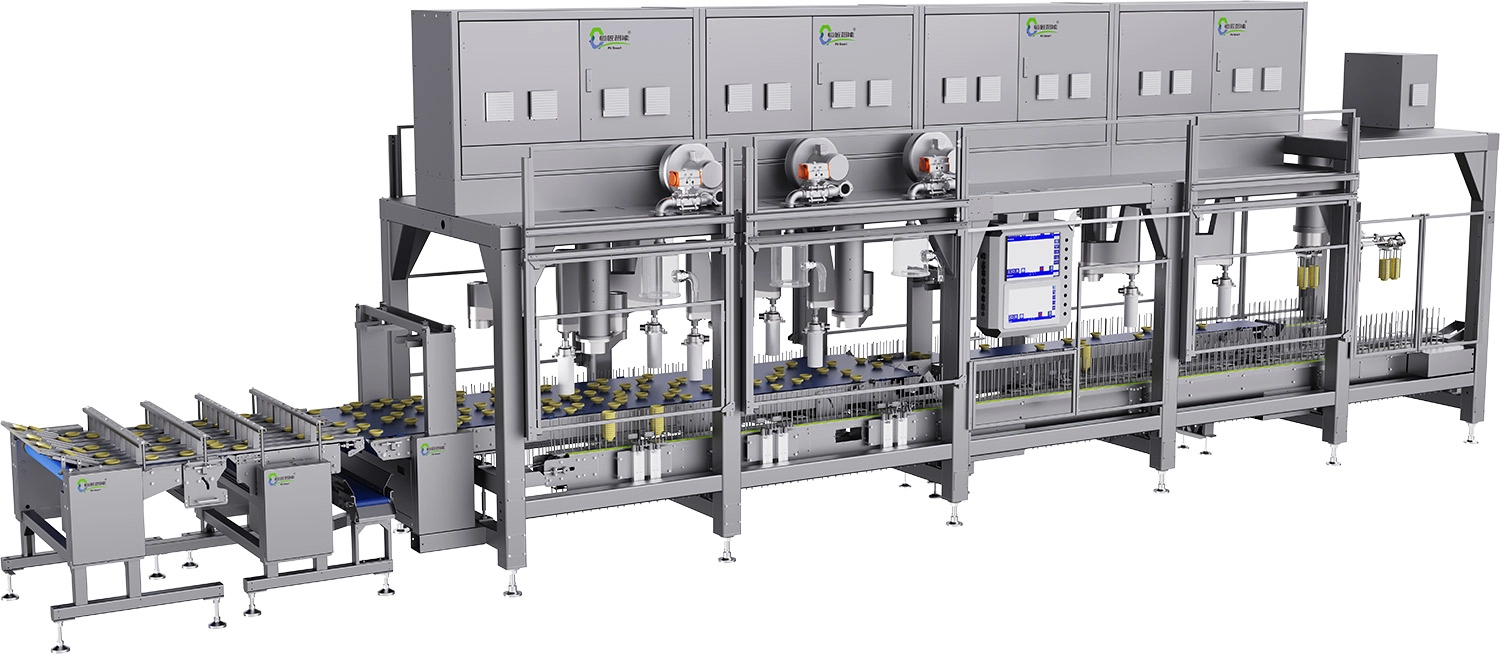
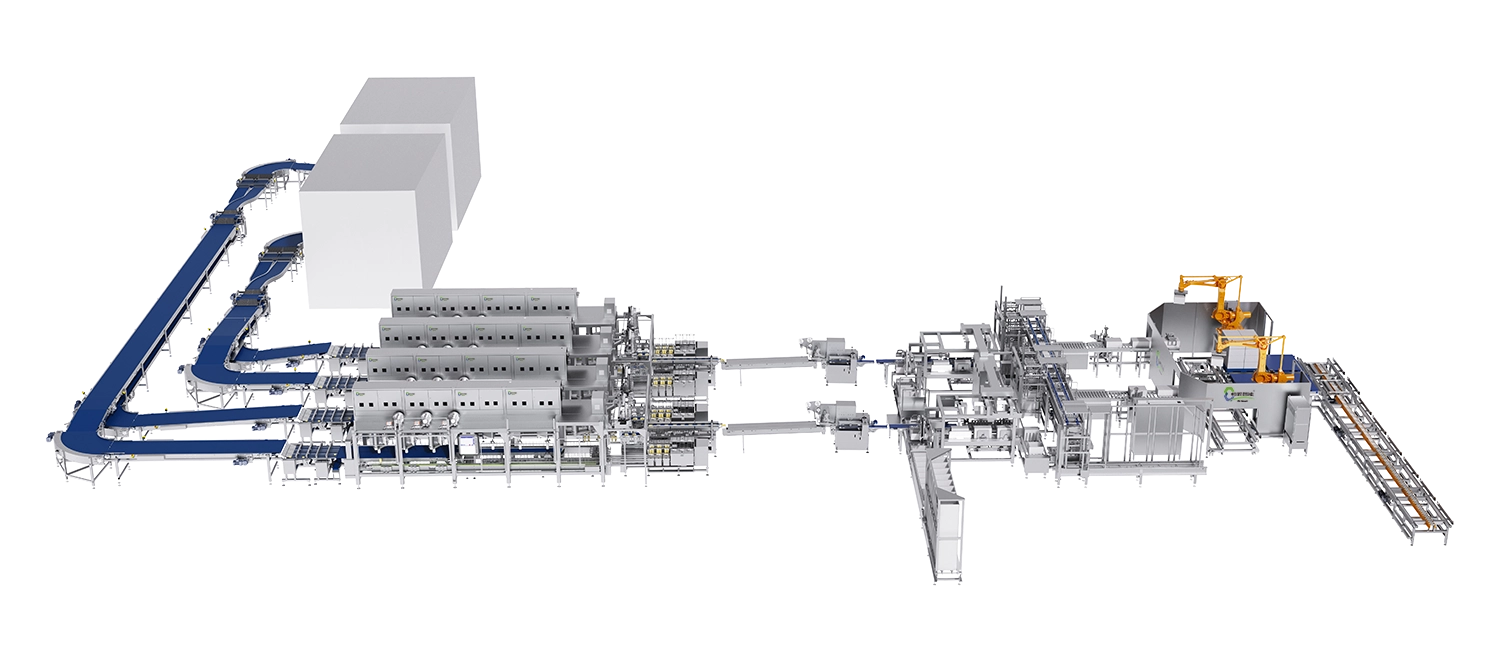
The SCARA robot sorting packaging line from Hengjiang is a complete production system that takes unsorted food products at the inlet and delivers filled, sealed cartons or trays at the outlet — with no manual intervention between these two points. This line-level solution represents the highest level of integration in Hengjiang's robotic portfolio and is designed for manufacturers running large-volume SKUs with strict output consistency requirements.
System architecture: The line consists of six functional zones arranged in linear or L-shaped layouts to suit available factory floor space. Zone 1 is the infeed buffer, where products from an upstream baking or freezing process are received onto a spreading conveyor that disperses them into a single layer for vision inspection. Zone 2 is the vision inspection station, which performs 100% product inspection for dimension, shape, color uniformity, and surface defects. Zone 3 is the SCARA robot picking zone, where one or two SCARA robots perform coordinated pick-and-place of accepted products into trays or packaging molds positioned on a parallel indexing conveyor. Zone 4 handles tray filling verification via a weight-check scale integrated into the outfeed of the robot zone. Zone 5 is the automatic tray lidding or cartoning module, which applies film or paper lids and seals tray edges. Zone 6 is the case packing and palletizing module, which groups sealed trays into shipping cases and stacks them on pallets.
Application: Frozen Egg Tart Shell Sorting and Packaging Production Line. Demolded frozen egg tart shells enter the line at Zone 1 at rates up to 200 pieces per minute. The vision system at Zone 2 identifies and rejects broken or deformed shells (typically less than 2% of output in a well-maintained forming line). SCARA robots at Zone 3 place accepted shells into 6-cavity or 12-cavity plastic trays indexed on the parallel conveyor with ±0.5 mm tray positioning accuracy. The completed line delivers sealed, labeled trays ready for cold-chain distribution. See the upstream Hong Kong-style egg tart forming production line for context on how formed shells are produced before entering this sorting and packaging system.
Control integration: The entire line runs on a single supervisory PLC with a 21-inch touchscreen HMI. Each zone's sub-controller communicates with the supervisory PLC via PROFINET. Operators can monitor zone-by-zone throughput, alarm history, reject rates, and OEE (Overall Equipment Effectiveness) metrics in real time. The system supports recipe storage for multiple product SKUs; changeover between SKUs requires only a recipe selection on the HMI plus a physical end-effector and tray format change, achievable in under 15 minutes.
Footprint and utilities: A full line for egg tart shells occupies approximately 15–20 m in length and 3–4 m in width. Power requirement is 380V three-phase, 50 Hz, typically 15–25 kW total connected load. Compressed air at 0.6 MPa is required for gripper actuation and pneumatic tray clamping. Water connections for CIP (Clean-In-Place) are optional depending on hygienic zone classification of the facility.
The automatic donut sorting packaging line at Hengjiang combines SCARA and delta robots in a coordinated configuration specifically optimized for the physical characteristics of donuts — round or oval shapes, soft deformable texture, varied glazing surfaces, and high line speeds from high-capacity fryers or proofers. This line is documented in the combined use of SCARA and delta robots section of Hengjiang's integrated workstation portfolio.
Why donuts require a specialized line: Donuts present unique handling challenges. Their soft, sticky surface makes vacuum cup selection critical — too much suction deforms the product; too little causes drops. Their circular geometry means orientation control is less critical than for directional products, but consistent spacing in the packaging tray is essential for presentation. High-volume donut lines (industrial fryers producing 3,000–6,000 pieces per hour) require robot clusters capable of sustained throughput without fatigue-related performance degradation over multi-shift operations.
Line configuration for donuts: Delta robots handle the primary high-speed pick-and-place task from the fryer outfeed conveyor into intermediate trays. Their cycle rates of 60–100 picks per minute per unit, combined in a three- or four-robot cluster, match industrial fryer output rates. SCARA robots then handle the secondary task: picking pre-sorted donuts from intermediate trays and placing them into retail packaging with precise orientation, count verification, and layer stacking. This division of labor plays to each robot type's strength — delta for raw speed, SCARA for precision placement and heavier payload.
Glazing compatibility: The end-effector tooling in the donut line is engineered for glazed, sugar-coated, and plain surfaces. Silicone suction cups with adjustable vacuum regulators compensate for surface variation. The vision system's reflectance-normalization algorithm handles the contrast variation between matte and glossy glazings without requiring separate calibration per product variant.
Integration with the forming line: This packaging line interfaces directly with Hengjiang's donut forming production line, creating a continuous production-to-packaging chain. Hengjiang offers turnkey project delivery covering both the forming line and the sorting and packaging line under a single contract, with unified commissioning and operator training.
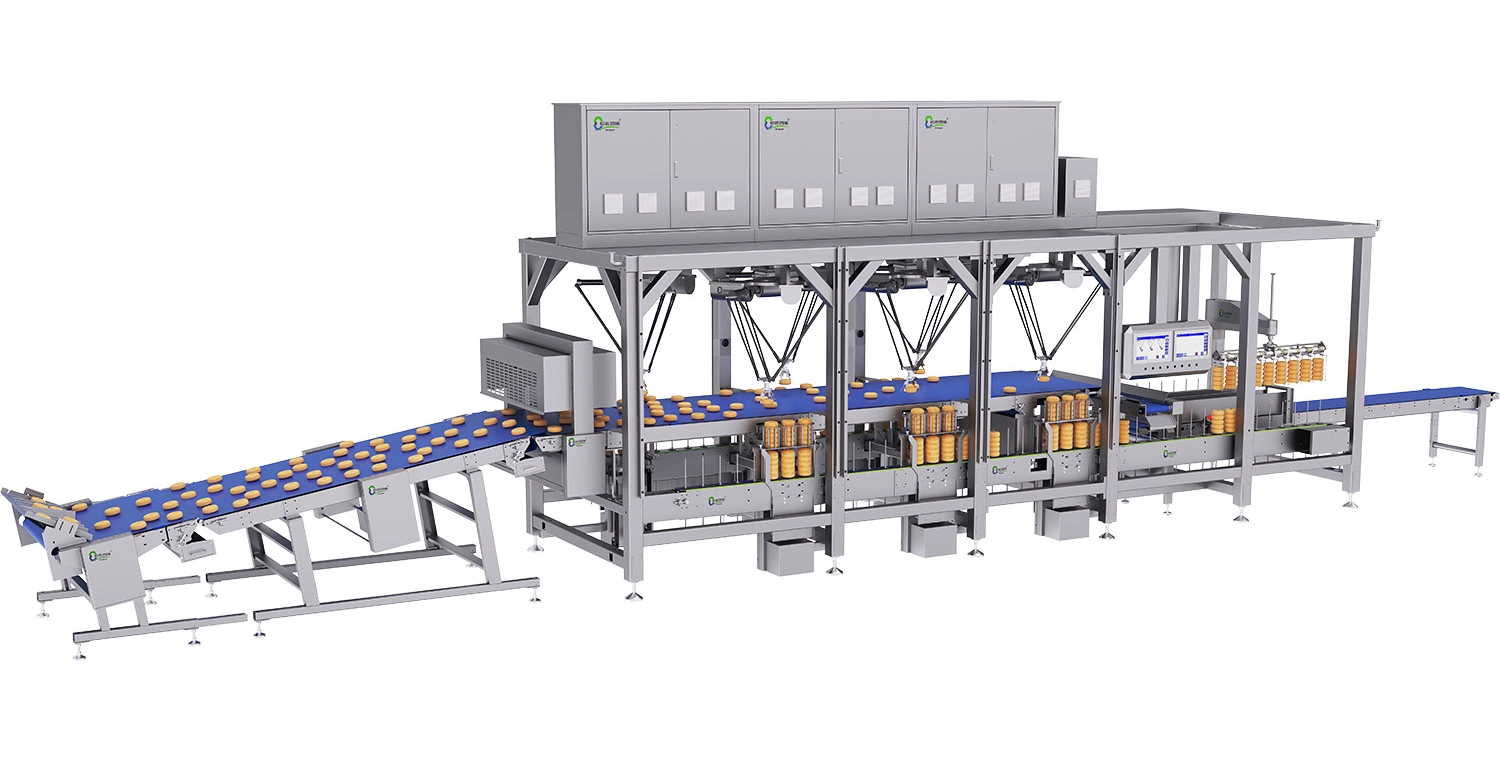
The automated pizza sorting packaging line at Hengjiang uses dual-unit or multi-unit delta robot deployments to handle frozen pizza sorting and packaging, addressing the specific challenges of flat, large-diameter food products that must be placed into cartons with millimeter-level accuracy.
Pizza-specific handling challenges: Frozen pizzas are large (200–350 mm diameter typically), relatively heavy compared to donuts or pastries (200–500 g per unit), and must be placed into close-tolerance carton sleeves without edge damage to the topping layer or crust. The packaging carton's inner dimensions leave only 3–5 mm clearance on each side, meaning the robot's placement accuracy and repeatability must be tighter than the clearance tolerance. Hengjiang's HJ-D11003-1 with rotating axis achieves ±0.5 mm placement repeatability in the XY plane at full operational speed — well within the required tolerance for standard pizza carton formats.
Dual-unit and multi-unit delta configurations: Pizza lines documented in Hengjiang's portfolio include Pizza Sorting and Packaging Line A and Pizza Sorting and Packaging Line B, representing different throughput tiers and layout configurations. Line A uses a two-robot delta cluster for medium-capacity lines (800–1,500 pizzas per hour). Line B uses a three- or four-robot cluster for high-capacity lines matching the output of industrial deck ovens or tunnel baking systems. Both lines use the same vision and control architecture, differing only in robot count and conveyor width.
Carton erecting and sealing: The packaging line integrates an automatic carton erector at the inlet of the packaging zone, a robot-loading module where delta robots place pizzas into erected cartons, and a hot-melt glue sealing station at the outlet. A print-and-apply labeling system applies variable information (batch code, best-before date, weight) immediately after sealing. The entire sequence from pizza pick to labeled sealed carton completes in under 8 seconds per unit on the high-capacity line.
Cold zone considerations: Frozen pizza lines operate in low-temperature production zones (typically 0°C to 10°C ambient). Hengjiang's delta robots are specified with low-temperature grease for all bearing surfaces and sealed motor windings rated for sustained operation in cold-room environments. Condensation management in the electrical cabinet uses thermostatically controlled heaters to prevent moisture accumulation during temperature transitions.
Upstream integration: The pizza sorting and packaging line connects directly to Hengjiang's pizza forming production line and the associated baking tunnel output. This allows a complete pizza factory automation project to be sourced from a single supplier, simplifying project management, warranty responsibility, and long-term service coordination.
For video demonstrations of both pizza line configurations in operation, visit the baking robot video section.
Hengjiang Intelligent Technology Co., Ltd. is a vertically integrated manufacturer: mechanical design, servo drive development, robot motion control software, machine vision algorithms, and system integration are all performed in-house. This means there are no inter-supplier compatibility risks in the critical interfaces between robot, vision, and control — a common failure point in third-party integrated systems.
All equipment undergoes a rigorous factory acceptance test (FAT) at Hengjiang's facility before shipment, simulating customer production conditions with representative products. Installation and commissioning are performed by Hengjiang's own technical team. Post-commissioning support includes remote monitoring via the IoT-enabled control platform, with real-time access to fault logs, cycle data, and performance metrics. For a full description of the service framework — including equipment inspection protocols, installation standards, and warranty terms — refer to the service and support page.
Hengjiang also offers complete baking production lines covering pastry, croissant, egg tart, donut, pizza, and pie categories. When a robotic sorting and packaging line is paired with a Hengjiang forming and baking line, the result is a fully automated smart factory cell with a single point of technical accountability. Explore the full production line portfolio for upstream equipment options, or visit the Hexeon Group company page for company background, manufacturing capacity, and culture information.
For product-specific inquiries, pricing discussions, or factory visit arrangements, use the contact page to reach Hengjiang's technical sales team directly.